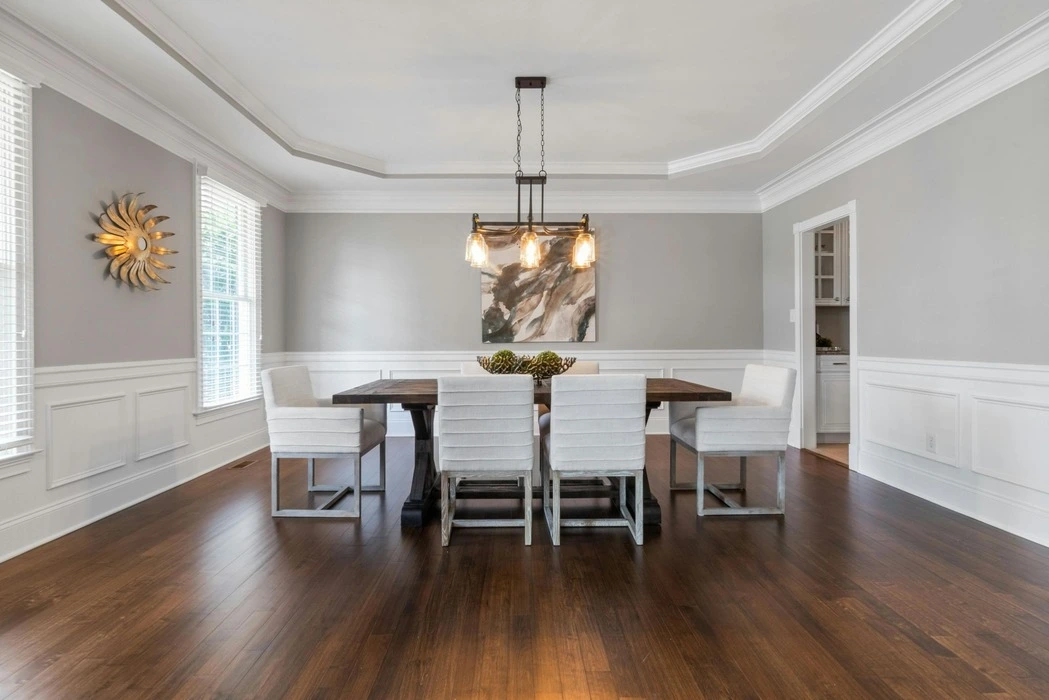

Solid hardwood flooring is the classic flooring material that you’ve undoubtedly seen countless times before. Made from a single piece of natural wood, solid hardwood flooring comes in all sorts of different species, sizes, thicknesses, and finishes, allowing a lot of design flexibility that makes it easy to achieve the specific look and feel you’re going for.
One of the biggest reasons homeowners choose hardwood flooring is its impressive longevity. With proper maintenance and the occasional refinishing, solid hardwood flooring can last for decades and maintain its timeless visual appeal and resale value for generations to come.
That being said, hardwood does tend to be the more expensive of the two options, and also doesn’t work well in environments with excess moisture or humidity.
Engineered wood flooring is a bit different in that it, too, is made with real hardwood, but only on the surface. Underneath, this type of flooring features multiple layers of plywood or composite material that gives the flooring added stability and helps reduce movement caused by humidity changes.
At first glance, you probably won’t be able to tell the difference between engineered wood and solid hardwood because both feature genuine wood on the surface. The biggest difference here is that engineered hardwood’s layered construction makes it much more durable and versatile.
Engineered hardwood products are much more moisture-resistant than traditional hardwood, which allows you to install them in the more moisture-prone areas of the home, like basements, bathrooms, and kitchens. It also tends to be the more budget-friendly option, which is a big factor to consider when planning a new flooring project.
Because both of these types of flooring use real wood, you probably won’t be making the decision based solely on appearance. Both options offer that classic hardwood flooring style and offer plenty of options when it comes to species, plank sizes, and finishes. So, if style is truly the only thing that you care about, you really can’t go wrong with either option.
Moisture performance is one of the biggest differences in the hardwood vs engineered wood flooring conversation. Engineered hardwood flooring simply handles humidity and temperature fluctuations a lot more effectively than traditional hardwood due to its layered design.
This makes engineered hardwood flooring a much better choice for basements, kitchens, and homes with high levels of humidity.
Both of these types of flooring also offer impressive longevity if you can maintain them properly. However, traditional hardwood typically has the advantage here as its solid hardwood construction allows for multiple refinishing throughout its lifetime.
Engineered flooring longevity depends almost completely on the thickness of the top wood veneer layer. Though higher-quality engineered products can still provide decades of performance, you’ll only be able to refinish them once or twice at most.
Traditional hardwood flooring is usually nailed or stapled to a wood subfloor, which means that installation can take a lot longer. This is especially true when you consider that most hardwood floors require sanding and finishing after the initial installation.
Engineered flooring usually offers a quicker, easier, and cheaper installation experience. Depending on the product, it may be floated, glued down, or installed with a click-lock system, which also makes engineered flooring suitable for a wider variety of subfloors.
Budget is always one of the most important factors in any flooring project, and both solid and engineered hardwood flooring can vary drastically depending on the wood species, plank width, finish, construction quality, and installation cost.
In general, solid hardwood is more expensive upfront than engineered hardwood, but it can make up for these higher initial costs through long-term performance and added home value. Engineered hardwood is often the much more budget-friendly option, offering similar visual appeal with less focus on generational longevity.
The choice between engineered hardwood vs solid wood flooring most often comes down to where you want to install the flooring in your home.
Solid hardwood works beautifully in formal living spaces, bedrooms, and main-level areas where homeowners want a timeless and long-lasting floor. Its refinishing potential also makes it attractive for homeowners planning to stay in their home for many years.
Engineered flooring is the much smarter choice for spaces where moisture and temperature fluctuations are more common, like kitchens, basements, and bathrooms.
At the end of the day, if you want a classic hardwood look that can last for decades and add value to your home, solid hardwood is probably the best option. However, if you want to achieve a similar look with something more budget-friendly and moisture-resistant, engineered hardwood is most likely the right choice for you.
Are you still trying to figure out which side of the engineered wood flooring vs. hardwood debate you’re on? Give us a call at (610) 385-3833.
Our friendly team of local flooring experts is always here to answer questions and will happily walk you through the advantages and disadvantages of all of the best engineered hardwood and solid wood flooring options. We even offer free estimates and samples so that you have all the information you need to make the right decision for your next flooring project.
Don’t get stuck figuring out whether hardwood or engineered wood flooring is the best choice for your home or business. Contact My Dad’s Flooring America and start your next flooring update today.
